Recently, my friend Zeynep and I were working on a project when she told me a story from her childhood. As a child, she would watch the trees and the wind. She never believed the wind was shaking the trees. To her, the wind was simply how trees spoke to one another.
That image stayed with me.
Last year, I was fortunate enough to be accepted into a curatorial studies programme. More than any theory or methodology, one idea changed the way I see the world: nothing exists in isolation. An exhibition is not a collection of objects but a network of relationships. The venue speaks to the artworks. The artworks speak to one another. The wall texts shape the way we read them. Visitors respond, reinterpret, and become part of the work itself. Meaning emerges through these exchanges.
It made me realize that curating is, fundamentally, the practice of creating conversations.
There is a reason Hans Ulrich Obrist began his career with his Dialogues interview series. His project was never simply about documenting artists. It was about making visible the conversations that already shape culture. Curating is less about presenting answers than about creating the conditions for dialogue.
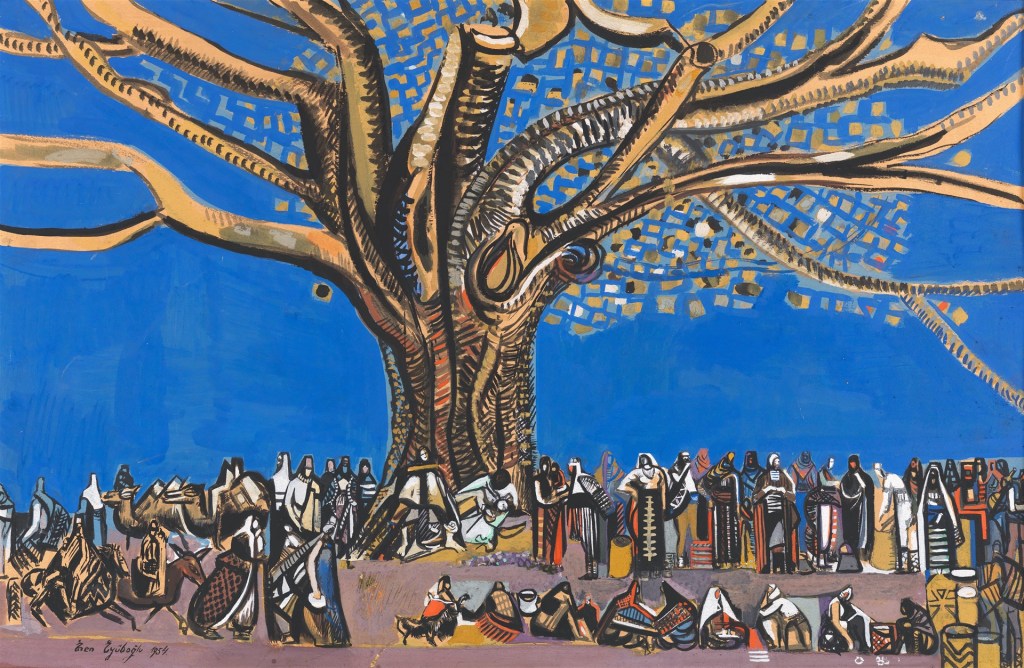
Ironically, “dialogue” used to be one of my least favourite words. When I first entered peacebuilding and civil society, it sounded vague, performative, almost empty. Everyone spoke about dialogue, but I struggled to understand what it actually accomplished. What changes simply because two people talk?
Then I became a facilitator.
I began to see that dialogue is not merely conversation. It is a process that changes everyone involved. People do not simply exchange ideas; they reshape one another’s assumptions, language, and possibilities. Something genuinely new can emerge that neither side could have produced alone.
Since then, I have started noticing dialogue everywhere. In exhibitions. In education. In friendships. Even in the way the wind moves through trees.
Perhaps dialogue is not something humans invented. Perhaps it is one of the ways the world works.
Not only objects, people, and places, but our lives themselves exist through dialogue. We are neither the captains of our fate nor merely its servants. We are always in conversation with it.
A few weeks ago, while walking through a quiet, almost deserted street, I said to a friend, “I think I finally cracked the code of urban vitality.” A city comes alive through interaction. Conversations spill onto sidewalks. People interrupt one another’s routines. Ideas circulate. The moment those interactions disappear, a city becomes little more than buildings standing beside one another.
Life follows the same logic.
When dialogue stops, life begins to withdraw. Ideas die. Relationships die. Entire versions of ourselves disappear. Dialogue is not necessarily confession or constant communication. It is the continual back-and-forth that allows something to remain alive. A glance answered by another glance. A question that changes because someone else responds. Someone who invites your inner child out to play—and you answer.
Then another question occurred to me.
What happens when dialogue becomes impossible?
If dialogue is the condition of life, what becomes of everything we cannot say? When something reminds you of a friend, you send them a message. But what happens when you cannot? What happens when every thought, every feeling, every act of care has nowhere left to go? What becomes of a conversation that continues inside one person alone?
It can feel as though fate itself has fallen silent.
In Sufi thought, falling in love with another person is sometimes understood as a path toward loving the Divine. I have often wondered whether that is because love is never lost; it only changes its object.
Perhaps all the love meant for you now belongs to the world.
And perhaps I belong to the world a little more because of it.


Leave a Reply