Last summer I wrote a post on what the future would look like. The core prediction was simple: a split.
The most likely future is a split. A large part of the population will disappear into cheap dopamine, like the humans in Wall-E. No socialising, no dating, perhaps even no work as UBI experiments expand. A hollowed-out existence.
But the rest will shape the world, culture and history.“
For years, academics and entrepreneurs insisted that dystopia would arrive through VR glasses, immersive simulations, and bodily modification Wall-E scenarios made literal. I never found this convincing. It did not match observation. When news of the Facebook Metaverse shutdown emerged, it felt less like a surprise than a confirmation. Across decades, humans have tested many technologies. The ones that endure are not those that transport us into alternative realities, but those that distort the one we inhabit.
A headset is a paradox. The awareness of the device is a constant reminder that the experienced world is secondary. Humans resist that reminder. They do not mind mediation; they mind noticing it. Reality is already grim enough without being explicitly framed as optional.
Much of the discourse has focused on the narcissistic individual and narcissistic culture —most notably in the work of Jean Twenge and Christopher Lasch— often framed as delayed adolescence or missed milestones. This diagnosis is incomplete. The issue is not simply postponed responsibility. It is a loss of contact with reality itself.
Here Jean Baudrillard becomes unavoidable. Society now operates at the level of pure simulacrum: signs circulating without reference, images detached from substance. Populist politics do not correct this condition; they intensify it.


One of the most powerful individuals on earth, the President of the United States, uses social media less as a statesman than as a character. The line between relatability and unseriousness has been crossed. When power is no longer treated seriously, consequences do not disappear; they diffuse.
Populist communication spreads not because it convinces, but because it replicates. Its value lies in visibility, not persuasion. Once this logic dominates, even actors with corrective intentions adopt it, mistaking reach for legitimacy.
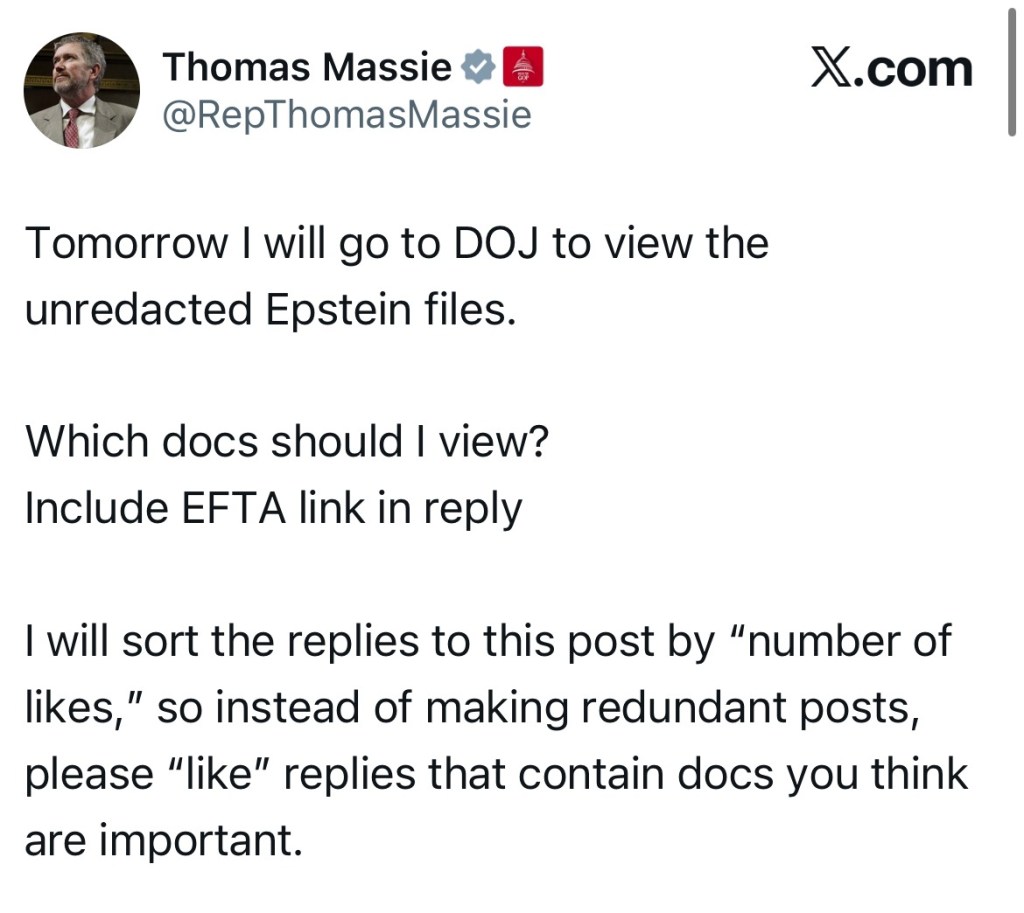
The Epstein files deepened public suspicion toward elites and institutions. They exposed how far those in power had drifted from the moral constraints that once legitimised authority, namely the bourgeois virtues that held systems together. Yet even politicians claiming to fight corruption often reproduce the same logic. When access to information or state action is conditioned on visibility, engagement, or public performance, governance is no longer exercised through institutional responsibility but through attention management. Asking for likes to unredact files shifts democratic authority from law and procedure to popularity metrics, substituting accountability with spectacle.
Parallel to Baudrillard, Robert Kegan’s theory of adult development offers a useful lens. Only a small fraction of adults reach a stage where they can question authority while also questioning themselves. What unfolds at the societal level mirrors this individual limitation. Psychological immaturity scales into political structure.
The result is not magical thinking but hyperreality. War, deportation, life, and death are processed as narratives. The immature individual is both isolated and eager to externalise agency. Power is handed over to entities that promise coherence. This is how totalitarianism re-enters, this time not through brute force, but through refined storytelling.
Polarisation, then, will no longer be primarily political. It will be ontological. It will be about proximity to reality. Some will opt into technologies, narratives, and tools that twist everyday experience. Others will have to carry the burden of interrogating reality down to its substance.
Between them emerges a volunteer class: compliant, dependent, symbolically engaged, and materially detached. Not coerced, but willing.
This is the fracture line. And it will determine what remains of society.
Further Reading
Jean Baudrillard — Simulacra and Simulation
Jean Twenge — The Narcissism Epidemic; iGen
Christopher Lasch — The Culture of Narcissism
Robert Kegan — The Evolving Self; In Over Our Heads
Deirdre McCloskey — The Bourgeois Virtues
René Girard — Violence and the Sacred; Things Hidden Since the Foundation of the World
 salpiozgur.com
Leave a comment