Ever since I first started traveling, the contrast I experienced between Istanbul and other European capitals was striking. Istanbul, my spiritual Heimat, makes objectivity a challenge, yet it’s a challenge worth facing.
What sets Istanbul apart?
The city’s early 2010s urban vibrancy, highlighted by art fairs and significant exhibitions like Dali’s, was abruptly halted by political and economic instability, leading to a cultural decline. The ruling party, AKP, sought cultural hegemony but only achieved censorship despite electoral successes. Ironically, Turkey’s younger conservative generation began embracing secular life, culture, and art.

As Turkey’s cultural capital, Istanbul has always struggled with creating vibrant “third spaces.” This challenge has deep roots. Effective urban planning typically stems from institutions with a long history, significant capital, and deep-rooted traditions. However, Turkey’s young republic, just a century old, struggled to preserve or restore many institutions from the Ottoman Empire due to war fatigue and political turmoil. Additionally, when Ankara became the official capital, many institutions relocated, leaving Istanbul to navigate its fate until the mid-1940s. Istanbul’s urbanization was further complicated by political polarization, internal migration, and flawed population projections.
Despite these challenges, Istanbul thrived, albeit temporarily. Then came the refugee crisis and economic downturn, eroding public trust and dimming the city’s famed hospitality and liveliness. While everything was going against our favor, In 2019 the local election victory of İmamoğlu, the leading opposition party candidate, brought a glimmer of hope. Gradually, Istanbul began receiving the attention and resilience it deserved in modern republic history. Which brings me hope regarding civil liberties in Turkey.
While liberal discourse often centers on economics, law, democracy, and education, discussions on physical spaces and gathering spots are sparse. Urban planning discussions often prioritize property rights over societal benefits. Even discussions on immigration tend to focus more on the economy than on urbanization. This is curious, as cities tend to be more liberal than rural areas. Historically, this traces back to bustling bazaars and marketplaces.
Commercial centers are vital for the economy but offer additional benefits, particularly for socialization, exposure to differences, and cultural enrichment. Commercial activities nurture culture, with each part of town taking on a distinct character based on its predominant businesses.
Spaces, buildings, and locations aren’t merely physical structures; they carry historical and ideological weight. Architects historically used design to convey political ideologies, shaping public behavior and perceptions. As an experience designer and a liberal, I often contemplate the divide between public and private spheres. In the digital age, physical spaces transcend their traditional roles, becoming something more. I won’t go into that now, but it’s something to keep in mind.
I view the distinction between private and public as fundamental to the difference between individualism and collectivism. Collectivist ideologies often blur these lines intentionally, sometimes leading to social engineering. While freedom begins with the private sphere, liberals should also engage in discussions about the public sphere, as neither individuals nor privacy exists in isolation. Exploring the public sphere further seems crucial to form a functioning society.
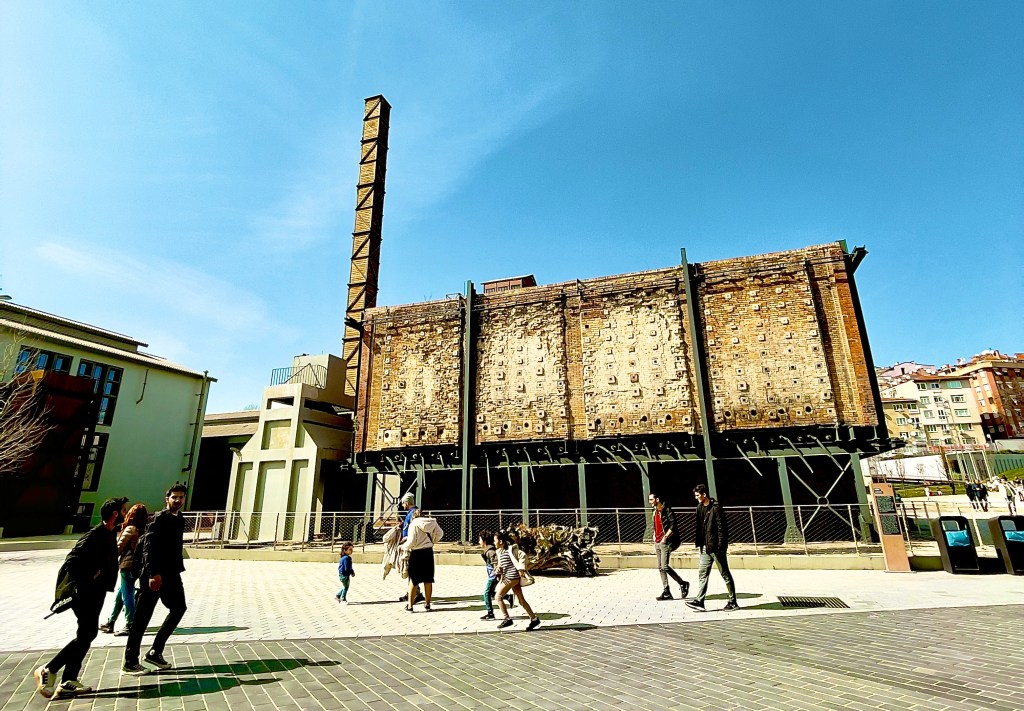
During a visit last March, I explored new spaces created under İmamoğlu’s leadership, focusing on renovating and opening up public spaces to everyone. Many of these spaces became museums, galleries, gardens, and open hangout spots, hosting events and workshops. Observing how people interacted in these places, I noticed a sense of belonging and ownership. It made me think, could it be that cohesion is more of a vibe than a sociological concept?
These spaces align with Oldenburg’s “third place” concept, fulfilling criteria like playfulness and freedom from home and work responsibilities. They provide environments for connection, communication, and coexistence, fostering a peaceful and convivial atmosphere. This aligns with my observations in Istanbul’s new spaces, where public trust seems to be growing. Increased awareness and connection to our immediate environment naturally lead to greater concern for local issues and solutions. Maybe, contrary to our assumptions, digitalization and the cybersphere aren’t the keys to democratization.
This leads to another point: the discourse on social media, the internet, and digitalization is ongoing, but many are already disillusioned, as I noted in my previous post. However, without physical spaces to connect, Houellebecqian dystopias may remain a risk. Could our next step be a return to local communities and rediscovering our physical boundaries? Integrating back into our towns and neighborhoods might provide the solace we seek through online escapism. Starting with third place could be the answer.
Oldenburg, R. (1999). The great good place: Cafés, coffee shops, bookstores, bars, hair salons, and other hangouts at the heart of a community. Da Capo Press.
Putnam, R. D. (2000). Bowling alone: The collapse and revival of American community. Simon and Schuster.
Houellebecq, M. (2000). Atomised (F. Wynne, Trans.). Knopf.
Istanbul Tarihi. (n.d.). Menderes dönemi İstanbul’unda imar hareketleri ve arka planı https://istanbultarihi.ist/325-menderes-donemi-istanbulunda-imar-hareketleri-ve-arka-plani
 salpiozgur.com
Leave a comment